
How to Run a Safety Awareness Campaign That Workers Actually Follow
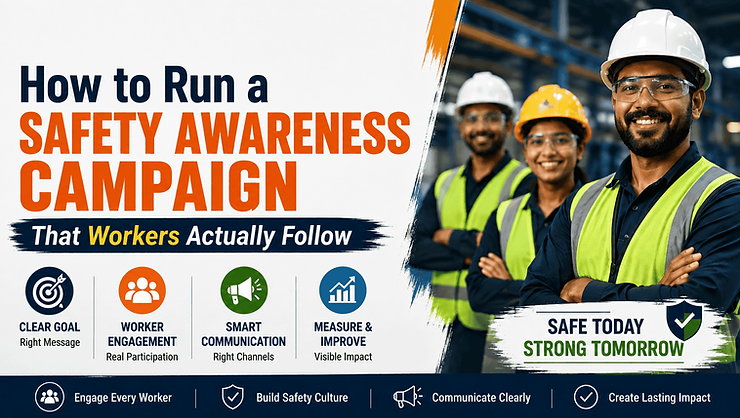
Most safety awareness campaigns are built backwards. The EHS team selects a theme, designs the poster, books the meeting rooms, and then asks how to get workers engaged, when worker engagement should have been the starting point.
A safety awareness campaign that workers actually follow is not a one-week event. It is a planned, structured, and measured communication effort built around specific workplace hazards, real workforce needs, and a clear plan for following through on what workers contribute.
This article is a practical execution guide for EHS Managers, Safety Officers, and Plant Managers who want to run campaigns that change behaviour on the floor, not just tick the compliance box.
Quick Answer
How do you run a safety awareness campaign that workers actually follow?
Start with a specific objective rather than a general theme. Design activities that require workers to participate actively rather than simply attend. Reach every shift and language group across your facility. Respond visibly to what workers contribute. A safety awareness campaign that workers follow is one where they have a defined role, their contribution is acknowledged, and management acts on what they report.
Key Takeaways
A safety awareness campaign without a specific objective rarely changes behaviour. Define what you want to be different before designing anything.
Activities must require workers to do something, not just sit through something.
Night shift and contractor workforces are frequently excluded from campaigns designed for day-shift, office-hour delivery.
Multilingual delivery is not optional in diverse industrial facilities. It is the difference between reaching your workforce and missing half of them.
Management response to worker contributions is the single most important factor in whether workers participate in the next campaign.
Measurement should focus on participation rates and observable behaviour change throughout the campaign, not only incident data at the end.
Why Safety Awareness Campaigns Lose Worker Engagement
There is a consistent pattern in how industrial safety campaigns typically fail, and it appears across manufacturing plants in India, construction sites in the UAE, and oil and gas facilities in Oman.
The campaign is announced on a Monday. Activities run through the week. Workers attend because attendance is tracked. By the following Monday, the facility looks and operates exactly as it did before.
Three factors consistently cause this:
No clear objective. Raising safety awareness is a direction, not a goal. Without a specific, measurable objective, such as increasing hazard reporting from the night shift, improving PPE compliance in Zone 3, or reducing forklift near-misses in the loading bay, the campaign has no clear way to succeed or fail.
Passive design. Posters, presentations, and one-way toolbox talks communicate information. They do not change what workers do. Campaigns built entirely around passive communication produce passive results.
No visible follow-through. When workers report a hazard during a near-miss drive and see no response within days, they draw a conclusion: this campaign was not actually listening. They will not contribute to the next one.
If you are looking for activity ideas to build your campaign around, Safety Campaign Ideas for Manufacturing and Industrial Workplaces covers 12 proven formats across different facility types and risk environments.
How to Plan and Run a Safety Awareness Campaign: Step by Step
Step 1: Set a Specific Campaign Objective
Before selecting a theme or designing a single activity, define what you want to change.
A strong objective sounds like: “By the end of this four-week campaign, near-miss reports from the night shift will increase, and the top three reported hazards will have corrective actions documented and visible.”
Weak: “We want to raise safety awareness across the plant.” Strong: “We want workers in the press shop to correctly identify the five machine guarding requirements relevant to their area.”
One objective. One campaign. Everything else follows from it.
Step 2: Select a Theme Rooted in Real Workplace Hazards
A theme that does not connect to the specific hazards workers face every day will not produce genuine engagement. Workers recognise irrelevant safety communication immediately.
Base your theme on:
Near-miss trends in your facility over the past quarter
Seasonal or operational risk changes, monsoon, new equipment, increased contractor volume
Areas where supervisor observations or audit data indicate gaps
For a full guide on selecting themes matched to specific industries, Safety Campaign Themes for Manufacturing, Construction and Oil & Gas covers this in practical detail.
Step 3: Map Your Workforce Before Designing Anything
Your campaign design must account for who is actually in your facility.
Shift structure. If your facility runs three shifts, a campaign that only operates during day-shift hours reaches one third of your workforce. Every shift needs equivalent participation opportunities, not the same content at different times, but activities designed to work within shift constraints.
Literacy levels. In many manufacturing plants in India and construction sites in the GCC, a portion of the workforce has limited reading ability. Visual-first materials, icon-based checklists, image-led quiz questions, and demonstrated activities are not a workaround. They are the right design approach for a mixed-literacy audience.
Language groups. In a large plant in Tamil Nadu, you may have Hindi, Tamil, and Telugu speakers. In a Dubai construction site, workers from India, Pakistan, Nepal, and the Philippines may be on the same team. A toolbox talk in one language does not reach all of them. Plan language coverage before the campaign starts.
Step 4: Choose Communication Channels That Reach All Shifts
Channel | Best Use | Shift Coverage |
Safety Notice Board | Ongoing updates, leaderboards, and results | All shifts when placed at entry and exit points |
Toolbox Talks | Direct team briefings | Must be scheduled for each shift |
WhatsApp Groups | Quizzes, reminders, and photo submissions | All shifts, asynchronous delivery |
QR Codes on Equipment | Hazard-specific content at the point of use | All shifts, available 24/7 |
Break Room Screens | Visual content and leaderboard updates | All shifts when screens run continuously |
Printed Shift Cards | Key messages during shift handover | Distributed to each shift |
QR codes placed near specific machinery or hazard zones are particularly practical in manufacturing and warehousing. Workers can engage at their own pace, content can be updated without reprinting, and participation can be tracked by location.
Step 5: Plan for Multilingual and Contractor Workforces
For multilingual workforces, the goal is not to translate every document. It is to ensure that:
Toolbox talk key points are available in the main languages spoken at your facility
Visual activities, including observations, photo campaigns, and hazard hunts, do not depend on written literacy in any one language
WhatsApp content can be sent through language-specific groups
Digital quiz questions use image-based formats where appropriate
For contractor workforces, the challenge is timing and consistency. Contractors arrive at different points during a campaign and often miss structured sessions. Build a contractor-specific induction element that can be delivered on arrival, not at a fixed session scheduled two weeks before they join.
Step 6: Build a Week-by-Week Campaign Calendar
A campaign without a structured calendar is an intention. For a four-week campaign:
Week 1: Launch activity, objective communication, and initial participation drive
Week 2: Mid-campaign engagement activity, plus first leaderboard or participation update
Week 3: Recognition of early contributors, plus an escalating activity to maintain momentum
Week 4: Final activity, measurement, visible management response, and formal recognition
Share the calendar with supervisors before the campaign begins. Supervisors are the campaign's frontline delivery mechanism. If they do not know what is happening each week, the campaign will not run consistently across departments.
Step 7: Launch With Visible Leadership Involvement
The way a campaign starts signals how seriously workers should take it.
A campaign that begins with an EHS officer putting up posters will be treated as an EHS team initiative. A campaign that begins with a plant manager or department head delivering the first toolbox talk, in person and across all shifts on launch day, signals organisational priority.
Visible leadership involvement does not require lengthy speeches. A five-minute shift start address from a senior manager, repeated across all shifts, is enough to change the perceived weight of the campaign.
Step 8: Measure What Actually Happened
Measurement starts on day one, not at campaign close.
Track throughout:
Number of participants per activity per shift
Near-miss and hazard reports submitted versus the pre-campaign baseline
Observation card completions
Supervisor-reported engagement quality across departments
At campaign close, review:
Did participation rates meet expectations across all shifts?
Which activities generated the strongest engagement?
What did workers report that requires management action?
What will change in the next campaign based on this one?
The answers shape the next campaign more than any planning document.
Planned vs Unplanned Safety Awareness Campaigns
Element | Unplanned Campaign | Planned Safety Awareness Campaign |
Objective | General awareness | Specific, measurable behaviour change |
Theme Selection | Based on calendar or availability | Based on facility hazard and incident data |
Workforce Coverage | Day shift, English-speaking workers | All shifts, all language groups |
Activities | Posters and presentations | Structured mix of active and passive formats |
Contractor Inclusion | Often excluded | Specifically accounted for in campaign design |
Leadership Involvement | Announcement only | Active delivery across shifts |
Follow Through | Rarely scheduled | Publicly tracked and timed |
Measurement | Incident rates, which are lagging | Participation rates and hazard reports, which are leading |
Common Mistakes That Undermine Campaign Effectiveness
Setting no specific objective. A campaign with no defined goal cannot be evaluated or improved. Define what you want to change before deciding how to run the campaign.
Scheduling all activities during the day shift. Night and weekend shift workers notice when campaigns are designed for the morning team. If a significant portion of the workforce does not encounter the campaign, they do not benefit from it.
Not closing the feedback loop. Workers test the system with one near-miss report or hazard submission. If nothing happens, they do not submit again. Every contribution during a campaign needs a visible response, even if the action is to explain why something cannot be changed immediately.
Choosing the theme without worker input. EHS teams often select themes based on management priorities. Workers on the floor may have different concerns. A one-question whiteboard vote or a brief pre-campaign conversation with shift supervisors produces better theme alignment.
Measuring only incident rates. Incidents are lagging indicators. They reflect the past, not whether the current campaign is working. Measure active participation and behaviour during the campaign itself.
Building campaigns that sustain engagement between events connects directly to How to Improve Safety Culture in Manufacturing Workplaces, where individual campaign habits gradually become embedded organisational behaviour.
Frequently Asked Questions
What is a safety awareness campaign?
A safety awareness campaign is a structured, time-bound communication and engagement effort designed to improve worker understanding of specific workplace hazards, encourage safe behaviour, and increase participation in safety reporting. In industrial environments, effective campaigns include active participation activities rather than passive information delivery.
How long should a workplace safety awareness campaign run?
Two to four weeks is the most effective duration for a major industrial safety awareness campaign. Shorter campaigns do not allow enough time for engagement to build across shifts. Longer campaigns can lose momentum without a highly structured activity calendar. Lighter activities, such as weekly quizzes, recognition boards, and observation cards, can run continuously between major campaigns.
How do you measure the success of a safety awareness campaign?
Track participation rates per shift, the volume of near-miss reports submitted during the campaign compared to before, hazard observations completed, and supervisor feedback on visible behaviour change. Incident rates are useful over the long term but too slow to reflect the impact of a single campaign.
How do you engage contract workers in a safety awareness campaign?
Design a contractor-specific element that can be delivered on arrival rather than at a fixed session time. Use visual, multilingual materials that do not depend on literacy in any one language. Include contractors in recognition formats and report participation data back to contractor supervisors.
What is the best way to reach multilingual workforces during a safety campaign?
Use visual-first formats, image-based quiz questions, and translated key messages in the languages most common at your facility. WhatsApp-based delivery supports asynchronous reach across shifts and language groups. QR codes can direct workers to content in the language most relevant to their work area.
How do you get workers to participate in safety campaigns?
Involve workers in choosing the campaign topic. Design activities that give them a specific role, such as reporting, observing, competing, or pledging. Ensure supervisors participate visibly rather than just monitoring. Respond to what workers contribute. Workers who see their feedback acted on become your most credible safety advocates within the team.
How should EHS teams involve supervisors in a safety awareness campaign?
Brief supervisors before the campaign launches so they understand the objective, weekly schedule, and their specific role. Supervisors should deliver shift-specific toolbox talks, update participation boards, and feed observations back to the EHS team throughout. A campaign supervisors treat as optional will be treated as optional by their teams.
What communication channels work best for industrial safety campaigns?
A combination of physical and digital channels reaches the most workers. Safety notice boards and toolbox talks provide structured communication. WhatsApp groups, QR codes at equipment, and break room screens maintain engagement between sessions and across shifts. The right mix depends on facility type and how workers actually access information during the working day.
Can a small EHS team run an effective safety awareness campaign?
Yes. The most effective campaign elements, including near-miss reporting drives, hazard hunt challenges, observation cards, and recognition boards, require supervisory involvement and organisational follow-through, not a large EHS team. Clear structure and consistent supervisor delivery matter more than team size.
How do you prevent campaign fatigue across multiple campaigns per year?
Rotate both the topic and the activity format each campaign. Involve workers in selecting upcoming themes. Ensure every campaign ends with visible action on what workers reported. More than any other factor, follow-through determines whether workers engage with the next campaign willingly.
Conclusion
A safety awareness campaign that workers actually follow is not built on better posters or longer presentations. It is built on a specific objective, activities that give workers a genuine role, delivery that reaches every shift and language group, and consistent visible follow-through on what workers contribute.
The campaigns that change behaviour in manufacturing plants in India, construction sites in the UAE, and oil and gas facilities in Oman share one characteristic: workers who participated felt that it mattered. Their reports were read. Their hazards were fixed. Their names were acknowledged.
The campaigns that change behaviour in manufacturing plants in India, construction sites in the UAE, and oil and gas facilities in Oman share one characteristic: workers who participated felt that it mattered. Their reports were read. Their hazards were fixed. Their names were acknowledged.
That loop, participation followed by visible response, is what determines whether your next campaign produces real engagement or just attendance. For EHS teams looking to build this into a structured, repeatable programme, working with experienced industrial EHS services in India that understand both campaign design and industrial workforce dynamics produces more consistent results than rebuilding the approach from scratch each time.
If You Are Planning Your Next Campaign
If you are planning an upcoming safety awareness campaign and want to determine which execution approach best fits your workforce profile and facility type, the team at Vikaki Enterprises offers safety awareness campaign services for EHS teams across manufacturing, oil and gas, and construction environments in India and the GCC, covering campaign planning, multilingual content development, and worker engagement programme design.


Comments