
Benefits of Industrial Safety Awareness Animation in Workplace Training
Updated: Jul 9

What are the benefits of industrial safety awareness animation?
Industrial safety awareness animation helps workers remember safety procedures more effectively, improves engagement across multilingual workforces, and reduces SOP violations on factory floors. Unlike printed manuals or one-time classroom sessions, animated safety videos provide consistent, visual, and language-neutral training that workers are more likely to retain, making them one of the most practical training tools for modern industrial EHS programs.
Key Takeaways
Safety animation helps improve knowledge retention by making complex SOPs easier to understand and remember
Animated safety videos are effective across multilingual workforces, helping overcome language barriers
Companies reduce repeated incidents and near-misses with consistent animated safety training
Safety animation can be easily deployed across multiple sites and shifts without additional trainer costs
Custom safety animations are designed around actual factory equipment, workflows, and hazard zones
Safety animation helps speed up onboarding and improves training effectiveness for new and contract workers
When Safety Training Stops Working
Every EHS manager has faced this problem.
You run an induction session. Workers sit through a two-hour classroom training. They nod. They sign the attendance sheet. Then, just a few weeks later, someone bypasses a machine guard, skips LOTO, or enters a confined space without following the SOP.
Not because they are careless, but because they simply did not retain what was taught.
Classroom fatigue is real. Language barriers in industrial workplaces are real. Generic training videos that show Western factories to workers in Rajasthan, Tamil Nadu, or Oman are also a reality. Yet none of these approaches fully addresses the actual problem.
This is why industrial safety awareness animation has evolved from a "nice to have" into an important training tool for manufacturing, oil & gas, construction, and warehousing companies across India and the GCC.
Why Traditional Safety Training Often Fails
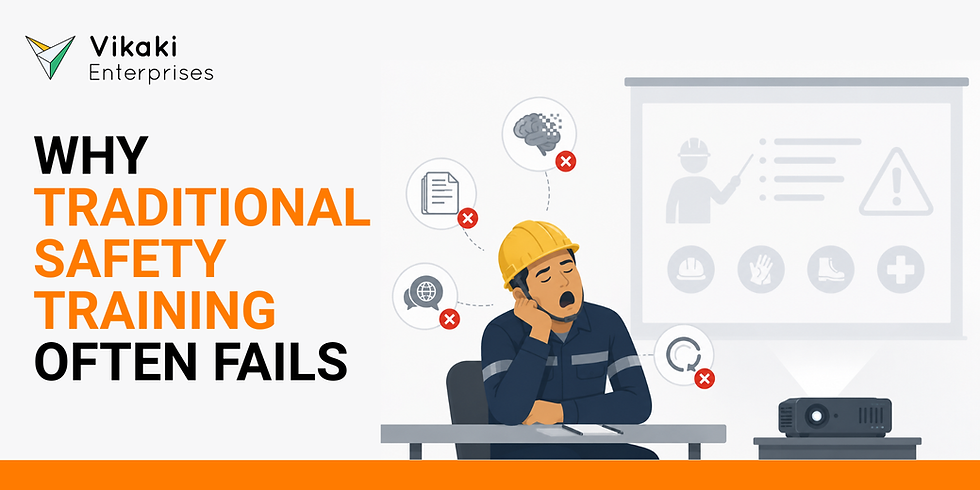
Before we discuss the solutions, it's important to understand why conventional safety training often falls short.
1. Low Retention After One Session
Industrial training assessments consistently show that workers retain much less from lecture-style safety briefings than EHS teams expect, especially when procedures are complex, involve multiple steps, or are delivered only once without reinforcement. Even a detailed one-time induction often fails to stay with workers for long.
2. Classroom Fatigue
After eight hours of shift work, sitting through a safety briefing in a conference room with a projector and PowerPoint presentation is rarely an ideal learning environment. Workers are physically tired, engagement is limited, and attention tends to fade quickly.
3. SOP Confusion on the Floor
Written SOPs are essential. However, a 12-page SOP document for operating a hydraulic press or entering a confined space is not the most effective way for many factory workers to absorb information. When procedures are complex or involve multiple steps, visual demonstrations are often easier to understand than text alone.
4. Multilingual Workforce Challenges
In Indian manufacturing, it is common to have workers speaking Hindi, Bengali, Tamil, Telugu, Odia, and Marathi, sometimes within the same plant. A single-language English training program can leave a significant portion of the workforce without a clear understanding of the training, regardless of their experience or commitment to the job.
5. Generic Training Content
A stock video showing a Western oil rig worker or a European construction site may not resonate with a line operator in Pune or a contract worker in Jubail. Familiarity and relevance play an important role in training effectiveness. When workers cannot relate to the content, the message is less likely to make an impact.
6. No Repeat Access
Traditional training is usually delivered once. If a worker joins midway through a cycle, returns after leave, or simply forgets a procedure, there is often no easy way to revisit the training. A video can be watched whenever needed. A classroom session cannot be replayed on demand.
What Is Industrial Safety Awareness Animation?
Industrial safety awareness animation refers to custom animated videos designed to explain workplace hazards, safety procedures, machine operation SOPs, emergency protocols, and EHS compliance requirements through visual storytelling, either as a replacement for or alongside in-person training.
These are not generic stock clips. They are developed to reflect your actual equipment, specific hazard zones, workplace workflows, and the language spoken by your workforce.
If you want to understand what safety animation videos for industries actually are, including their formats, production process, and how they differ from standard corporate videos, it is worth exploring that topic first before diving deeper into the benefits.
Top Benefits of Safety Animation Videos in Industrial Training

This is where the benefits become clear in real-world industrial training. Let's look at the practical advantages that EHS teams and plant managers commonly see after implementing animation-based training.
1. Better Knowledge Retention
Safety animation combines visuals, storytelling, and movement, making information easier to understand and remember than spoken instructions or text alone. Workers who watch an animated SOP for a hazardous task are more likely to remember the correct sequence of steps than those who receive only verbal briefings.
For high-risk procedures such as LOTO, hot work, working at height, and chemical handling, that difference in retention can play a critical role in preventing serious incidents.
2. Higher Worker Engagement
A well-produced safety animation keeps workers actively involved. They follow the character, recognise potential hazards, and understand the consequences in a format that feels more familiar and engaging than traditional compliance training.
Engagement is more than just a training metric. When workers pay closer attention, they absorb information better and are more likely to follow safe practices on the floor.
3. Better SOP Understanding
Animated safety videos can turn a 10-step SOP into a clear visual sequence that is easy to follow. Every action is shown rather than simply explained. Workers can clearly see both the correct and incorrect ways to perform a task.
For machine safety, chemical handling, and equipment maintenance, this level of clarity can help reduce SOP violations.
4. Safer Equipment Handling
Workers who watch animated demonstrations of safe equipment operation, including visual indicators for hazard zones, pinch points, and lockout/tagout points, tend to understand risks better than workers who receive only verbal instructions.
This is particularly valuable for new employees and contract workers who may not have had extensive hands-on equipment training.
5. Faster Onboarding
Safety animation helps standardise the onboarding process. Every new worker, regardless of shift or location, receives the same quality of safety training from Day 1 and in their preferred language.
There is no need to wait for the next induction batch, depend entirely on a trainer, or worry about differences in training quality across sites.
6. Multilingual Safety Communication
This is one of the most valuable benefits for industrial companies in India and the GCC.
Custom safety animation videos for industries can be created with voiceovers and on-screen subtitles in multiple languages, including Hindi, English, Tamil, Telugu, Bengali, Arabic, and Urdu. The same animation can be used with different language versions, making training more accessible across a multilingual workforce.
A single production investment can support safety communication across the entire organisation.
7. Consistent Training Quality
When training relies on individuals, whether a safety officer, EHS trainer, or supervisor, the quality of delivery can vary. Some trainers may cover every detail, while others may miss important points due to time constraints or other factors.
Safety animation provides consistency. Every worker receives the same information, presented in the same way, every time they watch the training.
8. Scalable Across Multiple Sites
A safety animation can be rolled out across multiple factories, sites, and countries at the same time without additional deployment costs.
For companies operating across India, the UAE, Oman, or other regions, this scalability makes it easier to maintain consistent safety training standards across all locations.
9. Stronger Near-Miss Prevention
Near-misses often occur because workers fail to recognise a hazard before it leads to an incident. Safety animation can recreate these situations in a safe and controlled environment, helping workers understand what causes a near-miss and how it can be prevented.
Watching a simulated scenario is often more memorable than reading about the same incident in a safety bulletin.
10. Stronger Workplace Safety Culture
When workers regularly receive clear, relevant, and language-appropriate safety communication, it reinforces the importance of safety across the organisation.
As a result, safety becomes more than a compliance requirement. Workers see it as a genuine priority, which helps build a stronger workplace safety culture over time.
Real Industrial Use Cases

Manufacturing
A machine parts manufacturer in Pune uses animated LOTO procedure videos in Hindi and Marathi during weekly toolbox talks. Within three months of implementation, repeat violations on specific machines were significantly reduced.
Construction
A highway construction company in the Middle East uses animated PPE awareness videos for contract workers coming from different countries and language backgrounds. A single Arabic-dubbed animation replaced a briefing process that previously relied on translators.
Oil & Gas
An upstream oil company operating across Oman and India uses animated confined space entry SOPs as mandatory pre-entry briefings. Workers scan a QR code at the entry point and watch a three-minute animated video before every entry, regardless of any previous training they may have received.
Warehousing
A logistics and warehousing company uses forklift safety animation as part of its new employee onboarding process. This helped reduce pedestrian-forklift incidents during the first 60 days of employment, a period that had historically carried the highest risk.
Chemical Plants
A chemical manufacturing facility uses animated emergency response videos covering spill response, evacuation routes, and fire suppression protocols. Since real drills cannot fully simulate these situations without introducing risk, animation helps bridge that training gap safely and practically.
Safety Animation vs Traditional Training: A Comparison
Factor | Traditional Training | Safety Animation |
Engagement Level | Low to medium | High |
Knowledge Retention | Drops quickly after the session | Sustained with repeat access |
Scalability | Limited by trainer availability | Unlimited — deploy anywhere |
Multilingual Support | Requires separate trainers or translators | Single production, multiple language layers |
Consistency | Varies by trainer | 100% consistent every time |
SOP Clarity | Verbal / text-heavy | Visual, step-by-step, process-accurate |
Repeat Access | Not available after the session | Always available — on demand |
Cost Over Time | Scales with headcount | Fixed production cost, low marginal cost |
Suitable for Contract Workers | Difficult and inconsistent | Immediate and standardised |
Workplace Hazard Simulation | Not safely replicable | Easily dramatised visually |
Why Industrial Safety Awareness Animation Works Better Than Traditional Training
The reason is simple: it comes down to how workers absorb and retain information on the job.
Visual learning tends to stay with people longer. When a worker sees a correct LOTO sequence animated step by step instead of just hearing it explained, the procedure becomes easier to remember and follow in real-world situations. Visual information is generally easier to recall than verbal instructions alone.
Easy access to training also makes a difference. A classroom session takes place once, but an industrial safety awareness animation can be watched before a shift, after a near-miss, during onboarding, or as part of a monthly refresher. There is no need to schedule a trainer or take workers away from the floor for extended periods.
Multilingual delivery is another major advantage. A single industrial safety awareness animation can be dubbed or subtitled in Hindi, Tamil, Arabic, Bengali, and other languages. One production can effectively serve an entire workforce, regardless of language.
SOP understanding improves when workers can see the procedure in action. A 12-step equipment shutdown SOP in written form can be easy to skim or misunderstand. When the same SOP is presented visually, in the correct sequence and with clear hazard indicators, it becomes much easier to follow correctly.
Worker engagement also plays an important role. When workers are actively watching and paying attention to a training video, they are more likely to absorb and retain the information. That creates a stronger foundation for safer behaviour on the job.
Signs Your Company Needs Safety Animation
If any of the following are true, your facility is a strong candidate for animation-based safety training:
Repeated incidents or near-misses on the same equipment or in the same area
SOP violations despite multiple briefings and refresher training
A multilingual workforce where language gaps reduce training effectiveness
High onboarding volume with new hires or rotating contract workers
Contractor-heavy workforce that cannot be sent through lengthy traditional induction programmes
Multiple sites where training quality is inconsistent across locations
With low trainer availability, your safety officer cannot be in four places at once
Post-incident reviews that repeatedly show "worker was not aware of the correct procedure"
Common Mistakes Companies Make With Safety Training Content
1. Using Generic Stock Videos
A stock video from an international library rarely reflects your actual equipment, hazard zones, or workforce. Workers recognise this disconnect, which can make the training less engaging and effective.
2. Producing Animation Once and Never Updating
Processes change. Equipment changes. Regulations change. Safety animations should be reviewed and updated regularly rather than being treated as a one-time project.
3. Ignoring Language
Creating a single English-language animation for a workforce that primarily speaks Hindi, Tamil, or other regional languages can leave important communication gaps in the training process.
4. Focusing Only on Induction
Many companies invest heavily in induction safety training and then stop there. However, ongoing refresher training, especially for seasonal workers, post-incident reminders, and SOP updates, is where safety animation often provides the greatest long-term value.
5. Skipping Customisation
Generic animation styles and characters that do not reflect your workers, factory environment, or equipment can reduce the relevance and impact of the training. Customisation is not just an added feature; it plays an important role in making safety training more effective.
FAQ: Industrial Safety Awareness Animation
What is Industrial Safety Awareness Animation?
Industrial safety awareness animation refers to custom-produced animated videos designed to train workers on workplace hazards, safety procedures, SOPs, PPE usage, emergency protocols, and EHS compliance using visual storytelling that is more engaging and easier to remember than traditional training methods.
How is safety animation different from a regular training video?
Safety animation is specifically created for industrial training. It uses animated characters, environments, and scenarios that reflect your actual workplace, equipment, and workforce, rather than relying on live-action footage that may not always be relatable or relevant to your work environment.
Can safety animation be customised for our specific factory SOPs?
Yes. Custom safety animations are developed based on your actual processes, equipment, hazard zones, and standard operating procedures. The animation is built around your workflow rather than a generic industrial template.
Is safety animation suitable for multilingual workforces?
Yes, and this is one of its biggest advantages. The same safety animation can be dubbed or subtitled in multiple languages, including Hindi, Tamil, Telugu, Bengali, Arabic, and Urdu, making it accessible to a multilingual workforce without requiring separate productions.
What factors affect the scope of a safety animation project?
The scope of a safety animation project depends on factors such as the number of topics covered, animation style, video duration, language versions required, and the level of workplace customisation. A single SOP video is a smaller engagement, while a full induction module series covering multiple hazard areas is a larger project. Most companies begin with their highest-risk procedures and expand over time.
How long should a safety animation video be?
For toolbox talks and SOP-specific training, 2–4 minutes is generally considered ideal. For full induction modules covering multiple topics, 8–15 minutes is common, often structured as a series of shorter animated safety training modules to improve retention.
What industries benefit from safety animation?
Manufacturing, oil & gas, construction, warehousing, chemical plants, pharmaceuticals, and heavy industries benefit the most from safety animation, especially where high-risk equipment, hazardous materials, or large contract workforces are involved.
Is animation better than classroom training for safety?
It is not an either-or choice. Safety animation works best as part of a blended training approach, replacing generic classroom lectures for SOP explanation and hazard awareness, while allowing trainers to focus on site-specific walkthroughs, drills, and Q&A sessions.
Can we add our branding, safety mascot, or company logo to the animations?
Yes. Custom safety animations can include your company’s visual identity, safety mascot, logo, colour scheme, and workplace-specific scenarios.
How do we know if safety animation is working?
Track metrics such as SOP violation rates before and after implementation, near-miss frequency, post-training assessment scores, onboarding time reduction, and supervisor observations of correct procedure adherence. Most companies notice measurable improvements within 60–90 days of consistent use.
Conclusion: Animation Is Not a Trend. It Is a Training Standard.
The factories and EHS teams achieving strong safety outcomes today are not simply relying on better PowerPoint presentations. They are focusing on better communication that is visual, multilingual, accessible, and easy to revisit whenever needed.
Safety animation does not replace effective EHS leadership. Instead, it strengthens it. It helps communicate the SOPs your team has carefully developed and the hazard awareness your safety officers have worked to build, delivering that information consistently to every worker in their language and in a format that is easier to understand and remember.
If you want a clearer picture of the full spectrum of what is possible, understanding how safety animation videos work in industrial settings is a practical next step, covering production formats, delivery channels, and how companies are deploying these across sites.
A Note on EHS Support
For companies across India and the GCC that want to move beyond checkbox compliance and build truly effective safety communication, partnering with a dedicated EHS service provider in India can make a meaningful difference. A provider that understands multilingual workforces, SOP retention challenges, and the practical realities of industrial training can help improve both the quality and consistency of safety outcomes.
Ready to Explore Safety Animation for Your Facility?
If repeated SOP violations, language barriers, or inconsistent onboarding continue to create safety risks at your facility, animation-based safety training can be one of the most effective ways to improve procedure clarity and training consistency across teams.
A practical place to start is by identifying the two or three areas where your current training needs the most improvement, whether that's machine safety animated training, confined space entry, PPE compliance, or new contractor onboarding. These are often the areas where visual, repeatable, and multilingual training can make the biggest difference.


Comments